A customer tender asks for proof of renewable electricity. Group reporting needs a defensible Scope 2 figure. A lender or investor asks how your energy claims are evidenced. A board sets a Scope 2 target.
Each of these moments leads to the same question: how does a business that buys grid electricity actually show that it is using renewable power?
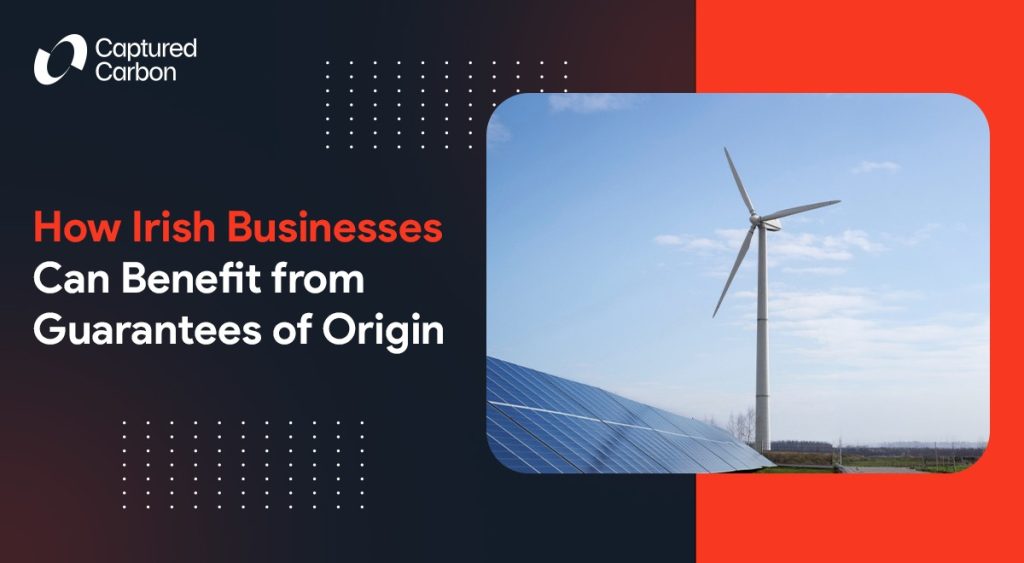
In Ireland, the answer starts with Guarantees of Origin. This guide explains what they give your business, why the Irish account rules shape how you reach them, and how to make a renewable electricity claim that survives scrutiny.
What Is A Guarantee of Origin?
A Guarantee of Origin (GO) is an electronic certificate that represents 1 MWh of renewable electricity. It is held in a registry, and in Ireland the issuing body is SEMO, with the Commission for Regulation of Utilities (CRU) acting as the competent authority. GOs are issued monthly.
The idea behind them is simple. Electricity on the grid is physically identical, whoever generated it. A GO separates the renewable attribute from the electrons and tracks it, so that one megawatt hour of renewable generation can be claimed once, by one party.
That is also what a GO does not do. Buying GOs does not make the electricity flowing into your site physically renewable. What it gives you is evidence: a verifiable record that a specific volume of renewable electricity was produced and that its attribute has been allocated to you.
What Irish Businesses Gain from Guarantees of Origin
The benefits are real, but they are only as strong as the evidence behind them. Each one below ties back to what a certificate proves.
1. A defensible renewable electricity claim:
For a business on grid power, cancelled GOs can evidence renewable electricity matched to your consumption. Supported generation may instead be evidenced through the supplier’s contract-based tracking and fuel mix disclosure. This is the foundation for any “renewable electricity” statement in a report, a tender response or a website.
2. A stronger market-based Scope 2 position is needed:
Under market-based reporting, cancelled GOs are the evidence that supports a lower reported emissions figure for the volume they match. Sustainability and group reporting teams need that evidence trail, not just a supplier assurance.
3. A route into customer and tender requirements:
Many procurement frameworks now ask suppliers to evidence their energy sourcing. A cancellation statement naming the beneficiary and period gives you something concrete to attach.
4. Answers for lenders, investors and auditors:
When someone asks how a renewable claim is supported, a documented chain from certificate to cancellation is a better answer than a policy statement.
5. Flexibility across your portfolio:
GOs trade across Europe through the AIB hub under the EECS standard, and Irish GOs can be imported and exported. For multi-site and multi-country businesses, this opens up options that a single local tariff cannot provide.
Why the Irish Account Structure Shapes Your Route
This is the point most guides skip, and it changes how you should approach buying. In the Irish GO domain, only electricity producers and suppliers can hold accounts. Trader-only accounts are not permitted. A business that simply consumes electricity cannot open an account and buy certificates directly.
So a business reaches GOs through a route that includes an account holder. In practice, that means one of four routes:
- A supplier arrangement, where your electricity supplier holds the account and the certificates are cancelled on your behalf.
- A power purchase agreement (PPA) that transfers certificates along with the energy.
- Your own supply company, which makes you an account holder in your own right.
- A procurement partner that manages sourcing, administration and cancellation for you.
The route determines what you can evidence, who manages cancellation, and how much control you have over your purchases. That is why this is a structured question before it is a purchasing question.
Guarantees of Origin, PPAs, or Both?
This is one of the most common decisions we see, and it is rarely either/or.
- GOs alone are flexible and quick to put in place. They suit businesses that need to evidence renewable consumption without a long-term commitment.
- A corporate PPA ties you to a specific generation over a defined term, and can carry the certificates with it. It suits businesses with long-term price and sourcing objectives.
- A combined structure uses a PPA for a core volume and GOs to match the remainder of consumption.
Whichever you choose, the discipline is the same: each megawatt-hour is claimed once. If a PPA already carries certificates for a volume, buying GOs for the same volume would be double counting. A clear structure prevents that.
Cancellation is Where the Claim is Made
A GO that is sitting in an account is not a claim. A certificate supports a claim only once it is cancelled for a named beneficiary and period. When a GO is cancelled, the record captures the purpose, the beneficiary, the consumption period and the country of consumption. The account holder can then generate an official cancellation statement. That document is what your reporting team, auditor or customer will ask to see.
There is also a clock. A GO is valid for 18 months from the production period. One that is not cancelled before expiry falls into the residual mix, and the claim is lost.
So the working questions are practical ones. Does the volume match your consumption for the period? Will the certificates be cancelled well inside the 18-month window? Who is responsible for doing it, and who holds the statement?
Supported Renewables Are a Separate Route
Another distinction that trips businesses up: no GOs are issued for generation that receives support under schemes such as REFIT or RESS. For disclosure purposes, the attributes of that supported generation are assigned to the supplier holding the PPA, and reach customers through supplier fuel mix disclosure instead.
The GO route and the supported-renewables route are therefore separate. A credible claim does not blur them. If your supplier’s product combines both, you should know the proportions.
Making a Claim That Holds Up
A lawful GO purchase can still support a misleading statement. In 2023, the Irish advertising regulator found that GO-backed “100% renewable” supply claims were misleading, even though the use of GOs themselves is lawful. The lesson is about wording. Good practice looks like this:
- Say what the certificates evidence: renewable electricity matched to your consumption, through cancelled GOs.
- Name the period and the volume.
- Avoid implying that your site is physically powered by renewable generation, or that the claim does more than the certificates support.
- Keep the cancellation statement on file.
Independent verification is the strongest protection. Any Irish supplier offering renewable products goes through verification by SEMO on behalf of the CRU, and businesses making their own claims benefit from the same rigour.
Three Objections, Answered
“Guarantees of Origin are just paper.”
They are a regulated, registry-held record of one megawatt hour of renewable generation, with an issuing body, a competent authority and a cancellation trail. What they do not prove is physical delivery or additionality. A good claim does not pretend otherwise.
“The certificates come from somewhere else.”
GOs record the origin of the generation, and the European system allows import and export. Origin is therefore something you can specify and discuss with your provider, rather than accept by default.
“Reporting rules are about to change.”
Proposals to revise Scope 2 guidance are under discussion, and current guidance remains in force while that work continues. The sensible response is not to wait. It is to build a structure that adapts: clear volumes, clear cancellation records, and a provider who tracks the standards. For the details, see our insight on potential sustainability reporting changes.
Building an Approach That Lasts
Businesses that handle this process well treat Guarantees of Origin as an annual cycle rather than a one-off purchase:
- Define the need. Which trigger is driving this: a tender, a reporting obligation, an investor question or a target?
- Choose the structure. GOs, a PPA, or a combination, and the route that gives you the access and control you need.
- Match the volume. Align certificates to consumption for the period, inside the validity window.
- Cancel and evidence. Cancel for a named beneficiary and period, and keep the statement.
- Review each year. Revisit origin, volume and structure as standards and your own consumption evolve.
The same logic underpins renewable matching for data centres and other large, multi-site users, where GOs and corporate PPAs often work together.
How Captured Carbon Can Help Import Guarantees of Origin in Ireland
Captured Carbon has worked in energy markets since 2007. Based in Malahide, Co. Dublin, we were the first company in Ireland to import a European Guarantee of Origin in 2012.
Today we provide an end-to-end GO service covering administration, issuance, procurement and cancellation, independent green energy verification, and supply company formation and management for large energy users.
If your business is weighing GOs, a PPA, or a combination, we can help you choose the structure, secure the certificates and build the evidence trail behind your claim.
Talk to our team about Guarantees of Origin for your business.
Generator or asset owner? See our page on Guarantees of Origin for renewable and low-carbon assets. Energy supplier? See our Utility Suppliers and Green Certificates pages.
Frequently Asked Questions
Not usually. Only electricity. Producers and suppliers can hold accounts in the Irish domain, so businesses typically reach GOs through a supplier, a PPA, their own supply company or a procurement partner.
No. A GO evidence that renewable electricity was produced and that its attribute is allocated to you. The grid electricity you consume remains physically the same.
A GO is valid for 18 months from the production period. What happens to a GO that is not cancelled in time? It expires and falls into the residual mix, so it can no longer support a claim.
Under market-based reporting, cancelled GOs provide the evidence for the renewable share of the volume they match.
No. A green tariff is a supply product. A GO is the certificate that can sit behind it. Understanding which certificates back a tariff and in what proportion is part of making a credible claim.
Yes, provided each megawatt hour is claimed once. A clear structure shows which volumes the PPA covers and which GOs cover.
You can state the volume and reporting period of electricity matched with renewable generation through cancelled Guarantees of Origin (GOs). Claims should be clear, specific and supported by records. Avoid wording that suggests renewable electricity was supplied directly to your site unless that can be demonstrated. Where appropriate, explain whether your claim is based on a PPA, GOs, or a combination of both.
Yes. Ireland has a renewable gas certificate registry. Gas Networks Ireland is implementing the updated Guarantees of Origin framework; ask the team about the current arrangements for your use case.